Update 2025: New Year, New Learning!
It’s a new year, and I wish you and your loved ones all well!
A lot of people set new goals around this time of year. Usually, my personal goals revolve around things like wellness, reading, and writing, but something I’ve been trying to do a lot more recently is to become more knowledgeable when it comes to my birdwatching!
Like many amateur birders, I tend to learn about birds through casual reading or the observations I make about our feathered friends while on hikes or nature walks. Recently, I decided to step up my learning about ornithology by joining online groups that focus on birdwatching and identification.
I’ve found these online communities incredibly helpful when it comes to bird identification. Some tips I’ve gleaned include paying attention to a bird’s beak shape to determine its diet (and thus, its species) or watching to see how extensive a particular pattern appears on the bird. These discussion I come across often lead me to research more and grow my knowledge when it comes to birds.
All of this new information had me thinking back on some of my older blog posts (like this one), and I wondered if I could go back and make better identifications of some of the birds I’ve written about in the past, or at least provide more information about them.
This blogpost in particular came to mind because I’ve learned a lot about mallards since last year. Specifically, I’ve learned that mallards have been heavily bred with other ducks. Overtime, these hybrids have produced a myriad of new domestic duck breeds. Put simply, it is easy for mallards to breed with a lot of birds outside of wild mallards, and it gives them a great genetic variety, which can show up in their coloring. This, in turn, can make it even more difficult for amateur birdwatchers like me to determine if a mallard truly is a leucistic bird, or just a bird who has a domestic parent (or ancestor) but chose to live on the wild side.
In other words, it seems that the more I learn about birds, the more questions I have!
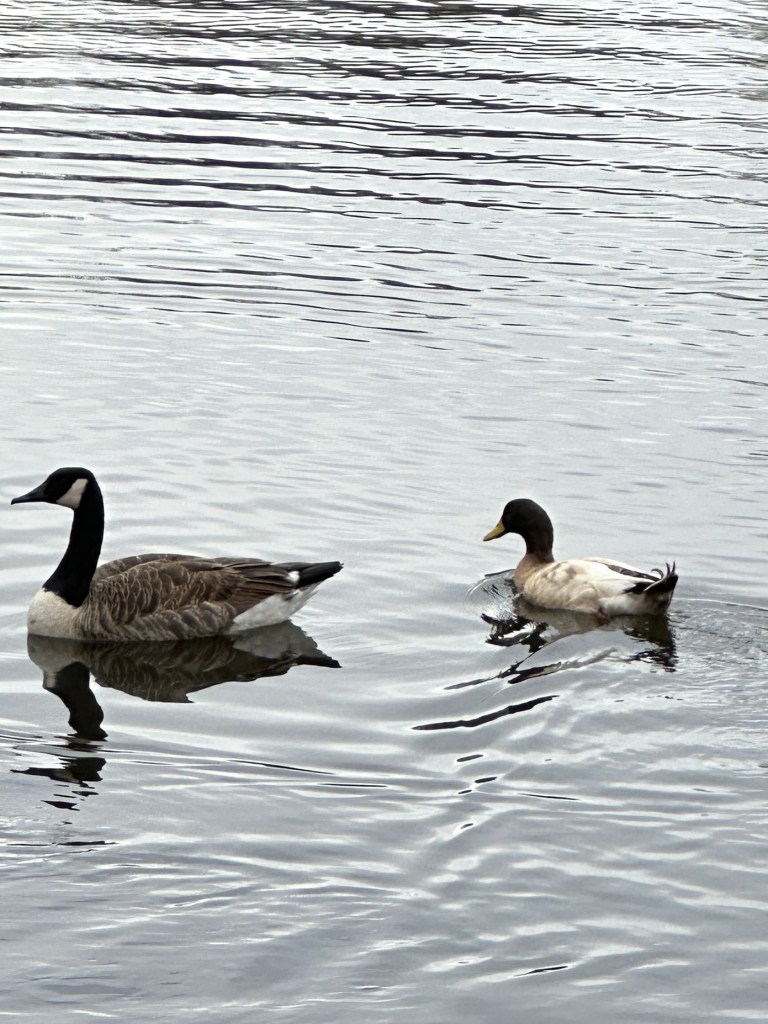
So, what do you think? Could the bird below be leucistic? Or maybe just a mallard hybrid or a domestic duck that has gotten a bit lost? Could it be something else completely?
[Original Post, January 27, 2024]
Normally, birdwatching in the winter months involves watching birds hunt on the frosted ground for remnants of berries and seeds, but this weekend, I was able to get outside and see some spring-like sights.
Currently, my area of the country is experiencing a rare warm-front. Because of this, I ventured to a local lake, and I had the pleasure of watching a variety of birds out and about who were enjoying the weather just as much as I was. I saw the typical winter birds that tend to be prevalent in much of the US and parts of Canada during January such as Canadian Geese and Mallards, but I also had the unique opportunity to spot what appeared to be a Mallard with leucism. Birds who have leucism will lack the coloring that many other birds in the same species possess, but not to the point that they can be considered albino. The one I spotted appeared to be a male based on his markings and lovely yellow beak.
Who knows though? Maybe the bird I spotted wasn’t a Mallard at all, but just a lonely waterfowl who made some odd friends as he was passing through. Check out the photographs below and let me know what you think!

 Nicolette Harpford