Birding With Warm Thoughts

With the holidays upon us, for many, it is that time of year for destination travel. So even though the temperatures are dropping outside my window, and I’ve been stacking the books up, readying myself for hours of reading under cozy blankets, I’ll be focusing my thoughts on someplace warm, maybe even tropical!

A lot of birds migrate in the winter months from the United States and Canada to the Caribbean, Mexico, and Central America, but not all birds travel far. Some are year-round inhabitants to the sun kissed tropics.

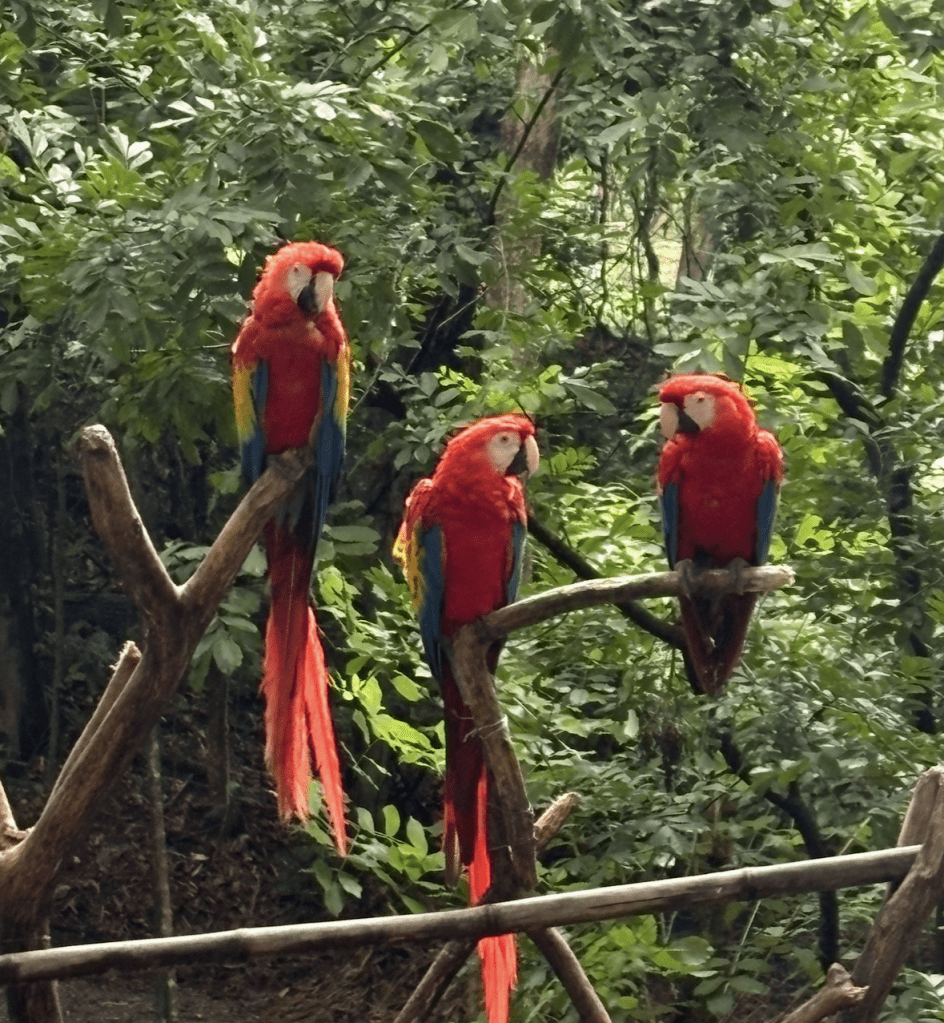
One of my favorite birds who doesn’t have to concern themselves with harsh winters is the Scarlet Macaw. This beautiful bird can be found in humid rainforests. Their lifespans are long for birds, with some able to live into their 80s or older. They are incredibly loud birds, with many mistaking their aggressive calls for other, often more dangerous, animals in the rainforest. Despite their vocalizations, they greatly enjoy socializing with others and preening their partners.

Three Scarlet Macaws at an eco-park in Honduras. These birds can freely roam the open forest.

Not all tropical birds seem as otherworldly as the Scarlet Macaw. Another bird that is easy to spot in the tropics is the great-tailed grackle. The males look similar to the common grackle seen in the United States and Canada with the exception being that the tropical counterparts are much larger. (This in itself is fascinating as animal species tend to be smaller when they live closer to the equator as opposed to away from it! Look up “Bergmann’s Rule if you would like a deep-dive.)

Male and female great-tailed grackles in Mexico.

So as the cold bears down upon many of us in the northern hemisphere, maybe the thoughts of these beautiful birds will keep you warm.

Sending you cozy thoughts. Until next time!

P.S. If you’re interested in learning more about bird migration, I recommend this interactive map from Audubon.org. The Indigo Bunting is a nice bird to start with since its winter and summer zones are easily distinguished on the map. I’m a fairly amateur birder, so I’m sure that others with more experience and knowledge will definitely enjoy the app as much as I did, if not more!

Pigeons in the Military and The American Pigeon Museum

Happy August! I hope wherever you are, you’re staying cool in all this heat!

One thing I love about summer is that it’s a great time to travel. I recently took a trip to Oklahoma City, and while I was there, I stopped at The American Pigeon Museum.

As someone who enjoys birdwatching, I couldn’t resist a short trip to the quirky museum, and let’s just say, I wasn’t disappointed!

Personally, I don’t know a lot about pigeons other than that they’re doves, and they are horrible nest makers. Visiting this unique exhibit changed that! I came away with so much interesting knowledge about these birds that seem to be everywhere in our cities and towns.

The museum was divided into three sections, and the one I found most fascinating was the military room. Like most kids in school, I had learned about pigeons being used to send messages during the World Wars, but the idea of studying them deeply never crossed my mind.  Well, my opinion on that has changed since visiting the pigeon museum!

Pigeons weren’t just a footnote during the World Wars, they were actually valued soldiers and members of the United States Army Pigeon Service (USAPS). At a young age, they were trained to fly hundreds of miles to be able to deliver messages in times of emergencies. Several pigeons even earned military awards for their bravery by delivering messages during battle. Two of the pigeons showcased in the museum that caught my eye were the decorated veteran Cher Ami, who was credited with saving 194 soldiers and went on to receive the Croix de Guerre (a prestigious French military award), and President Wilson (the pigeon, not the man!!), who was credited with delivering a message during WWI despite his leg and breast having been injured by gunfire.

If you are curious to learn more about these heroic animals, The American Pigeon Museum and Library is a great online resource as is the National Archives website.

I’ve included one of my favorite pictures from the museum below. It’s of a pigeon paratrooper ready for takeoff (or I suppose, ready for jumping?).

Birds at Ellis Island

Hello everyone, and happy almost June!

I think I’ve missed almost all of spring as I’ve been hidden away, finishing up the fourth installment of the Emma Finch series! It is now available on Amazon in paperback and eBook.

While I’ve been busy writing about Emma and have neglected my blog a tad, I’ve still had some fun birding experiences since I last wrote on here. My favorite by far was a trip I took to New York City to see Ellis Island.

I had planned the trip because I wanted to experience the place that so many people traveled to when coming to the United States, but I ended up finding something that I think my fellow bird enthusiasts will appreciate.

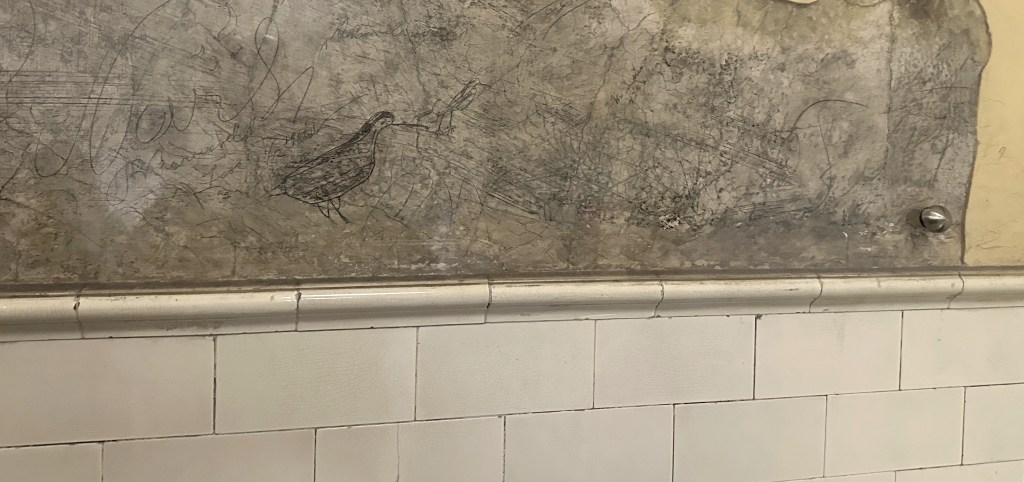
When people were processed on the island, they often spent long periods of time waiting in the Immigration Station. I’m sure as you all know, waiting for hours tends to lend itself to boredom. Our generation usually defaults to our phones in these scenarios (or for a lot of us readers, our books!), but I think we’ve all had a friend or two that doodles when they have time on their hands. Well, the same can be said for those who waited in those long lines at Ellis Island. Today, the museum still preserves small sections of the walls to show the graffiti that weary travelers left behind.

As I was going through the museum, imagine my delight at discovering one of those graffiti doodles was of a bird! I know many people love birdwatching, but seeing that someone took the time to draw a bird on the walls of Ellis Island reminded me that birdwatching isn’t just a hobby, it’s a pastime that humans have enjoyed for generations. It’s fascinating to think that when we go out looking for a certain bird, or even go hiking just to see what’s around, we’re participating in a tradition that our ancestors enjoyed so long ago.

You can see the picture below. What do you think it might be? Personally, I’m stumped.

Winter Watching

Update 2025: New Year, New Learning!

It’s a new year, and I wish you and your loved ones all well!

A lot of people set new goals around this time of year. Usually, my personal goals revolve around things like wellness, reading, and writing, but something I’ve been trying to do a lot more recently is to become more knowledgeable when it comes to my birdwatching!

Like many amateur birders, I tend to learn about birds through casual reading or the observations I make about our feathered friends while on hikes or nature walks. Recently, I decided to step up my learning about ornithology by joining online groups that focus on birdwatching and identification.

I’ve found these online communities incredibly helpful when it comes to bird identification. Some tips I’ve gleaned include paying attention to a bird’s beak shape to determine its diet (and thus, its species) or watching to see how extensive a particular pattern appears on the bird. These discussion I come across often lead me to research more and grow my knowledge when it comes to birds.

All of this new information had me thinking back on some of my older blog posts (like this one), and I wondered if I could go back and make better identifications of some of the birds I’ve written about in the past, or at least provide more information about them.

This blogpost in particular came to mind because I’ve learned a lot about mallards since last year. Specifically, I’ve learned that mallards have been heavily bred with other ducks. Overtime, these hybrids have produced a myriad of new domestic duck breeds. Put simply, it is easy for mallards to breed with a lot of birds outside of wild mallards, and it gives them a great genetic variety, which can show up in their coloring. This, in turn, can make it even more difficult for amateur birdwatchers like me to determine if a mallard truly is a leucistic bird, or just a bird who has a domestic parent (or ancestor) but chose to live on the wild side.

In other words, it seems that the more I learn about birds, the more questions I have!

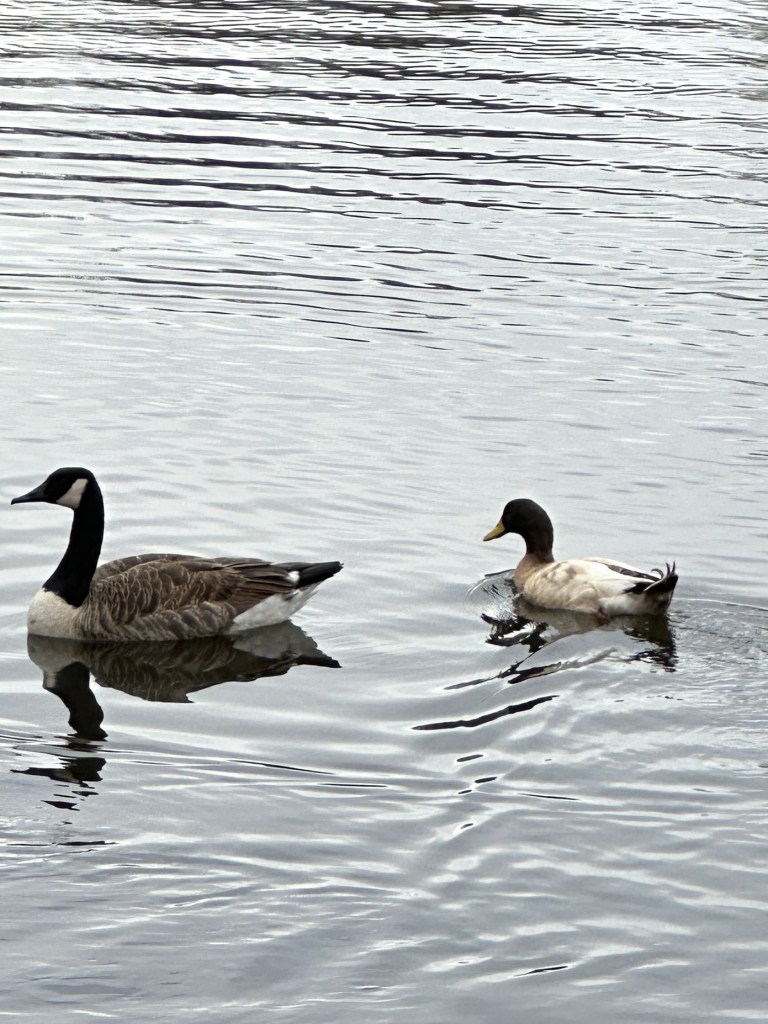
So, what do you think? Could the bird below be leucistic? Or maybe just a mallard hybrid or a domestic duck that has gotten a bit lost? Could it be something else completely?

[Original Post, January 27, 2024]

Normally, birdwatching in the winter months involves watching birds hunt on the frosted ground for remnants of berries and seeds, but this weekend, I was able to get outside and see some spring-like sights.

Currently, my area of the country is experiencing a rare warm-front. Because of this, I ventured to a local lake, and I had the pleasure of watching a variety of birds out and about who were enjoying the weather just as much as I was. I saw the typical winter birds that tend to be prevalent in much of the US and parts of Canada during January such as Canadian Geese and Mallards, but I also had the unique opportunity to spot what appeared to be a Mallard with leucism. Birds who have leucism will lack the coloring that many other birds in the same species possess, but not to the point that they can be considered albino. The one I spotted appeared to be a male based on his markings and lovely yellow beak.

Who knows though? Maybe the bird I spotted wasn’t a Mallard at all, but just a lonely waterfowl who made some odd friends as he was passing through. Check out the photographs below and let me know what you think!

The Mallard next to a Canadian Goose
The bird on the far right has the same body shape and bill as the other birds in his flock despite lacking similar coloring

Winter Coats

I hope you are all having a wonderful time now that the cold, winter season is upon us! Surprisingly, winter seems to be a contentious subject with some loving it and some despising it.

One thing I like about winter is the wardrobe. There’s something about a nice pair of boots that makes me feel warm and cozy. Another thing I know that keeps me toasty is a nice winter coat, but did you know people aren’t the only ones who have winter coats? Some birds shed their feathers and replace them with darker colors this time of year.

One that stands out to me is the starling. Unlike their shiny summer coats, they go speckled in the winter. The goldfinch is another bird that sheds its summer jacket for something a bit more mundane. Male goldfinches turn a bit olive when temperatures drop. I find this makes them trickier to identify in the winter than the summer since the males resemble pine warblers. Relying on range maps can be helpful in this scenario.

Not all birds shed their colors in the winter months. I think my favorite bird to see in the winter is the cardinal. The males retain their bright red bodies and black masks throughout the season and the females their dusky rose.

So, what’s your favorite winter bird?

Crow Season

Happy end of October! I hope that wherever you are, you are enjoying some of the fun activities autumn has to offer.

This weekend, I got into the festivities myself and carved a pumpkin. I tried my hand at creating a crow silhouette (other than the feet, it didn’t turn out too well!).

It’s easy to understand why birds like crows are associated with autumn. Their calls sound spooky, and their dark coloring and reaching wings remind us of night. But in general, I think crows get a bad rap.

Some people may be surprised to learn that crows are particularly smart creatures compared to many of their fellow birds. People familiar with the species know that they actually enjoy gift giving! Among those who count birdwatching as a hobby, it’s a common story to be heard that those who feed crows often times receive gifts from their flying friends in the form of shiny objects. (I’ve never had this happen to me, but then again, I haven’t had the chance to form any bonds with the local crows!)

The closest I’ve ever come to experiencing this unique ritual was between a mother crow and her offspring. While a large crow and what I presumed to be her two children explored a grove of trees, one of the smaller birds picked a fresh, green leaf off a branch and held it out towards the larger bird the same way a human child would to their parent. The mother bird didn’t take the leaf, but that didn’t deter the smaller bird from holding it out to her for a long time.

In my mind, I like to think I experienced an attempted crow gift-giving (but maybe I just came across a crow who was a little odd!). Anyway, I thought the small story fit well with the season since in a couple of days, children will be bounding about, trick-or-treating, and hoping that their neighbors will give them a small candy gift.

Happy autumn!

New Writings!

It’s the beginning of September, and it’s the beginning of a new chapter.

I’m excited to announce that the third book in the Emma Finch series is officially available on amazon in the eBook format! The paperback is coming very soon.

For this novel, I chose for Emma to focus on the American goldfinch.

The American goldfinch is a bird found across the United States and Canada. It is one of the most identifiable songbirds due to its bright yellow plumage. I find that it’s one of the few birds that stops people in their tracks regardless of if they are birdwatchers or not. While people tend to think it’s rare due to its plumage, it is a fairly common bird.

One of the reasons I chose to write about the goldfinch in general is because it is a timeless bird. It has captivated the interest of humans for centuries, often appearing in art as old as the Renaissance (obviously the American species isn’t found in the paintings, but you get the idea). I think the idea that people long ago found the bird as majestic as we do today is pretty unique. It makes me wonder if some of the great artists of the time period were birdwatchers just like us?

Happy birding!

A long overdue post

Welcome to the most recent entry of my bird blog! I know that I haven’t posted in a while, but the great news is that’s because I have been spending time working on the third installment of the Emma Finch series. I won’t dwell too much on it, but let’s just say Emma will be off to somewhere new again!

In terms of my own bird watching, I’m definitely not as dedicated to it as Emma is, but there are some fun things I thought I would touch upon now that it’s summer and the weather has changed.

With the higher temperatures, it feels like it is impossible not to catch some ducklings in the park swimming after their mother, but did you know that these baby birds aren’t the only type of birds that need some parenting? Fledglings are birds that are no longer babies, but they’re not exactly mature enough to be called adults, and in some cases, they’re still reliant on their parents for guidance. One thing a lot of birds do is teach their children how to forage for food—I guess it’s similar to how we teach our own children how to go to the grocery store (just kidding!)

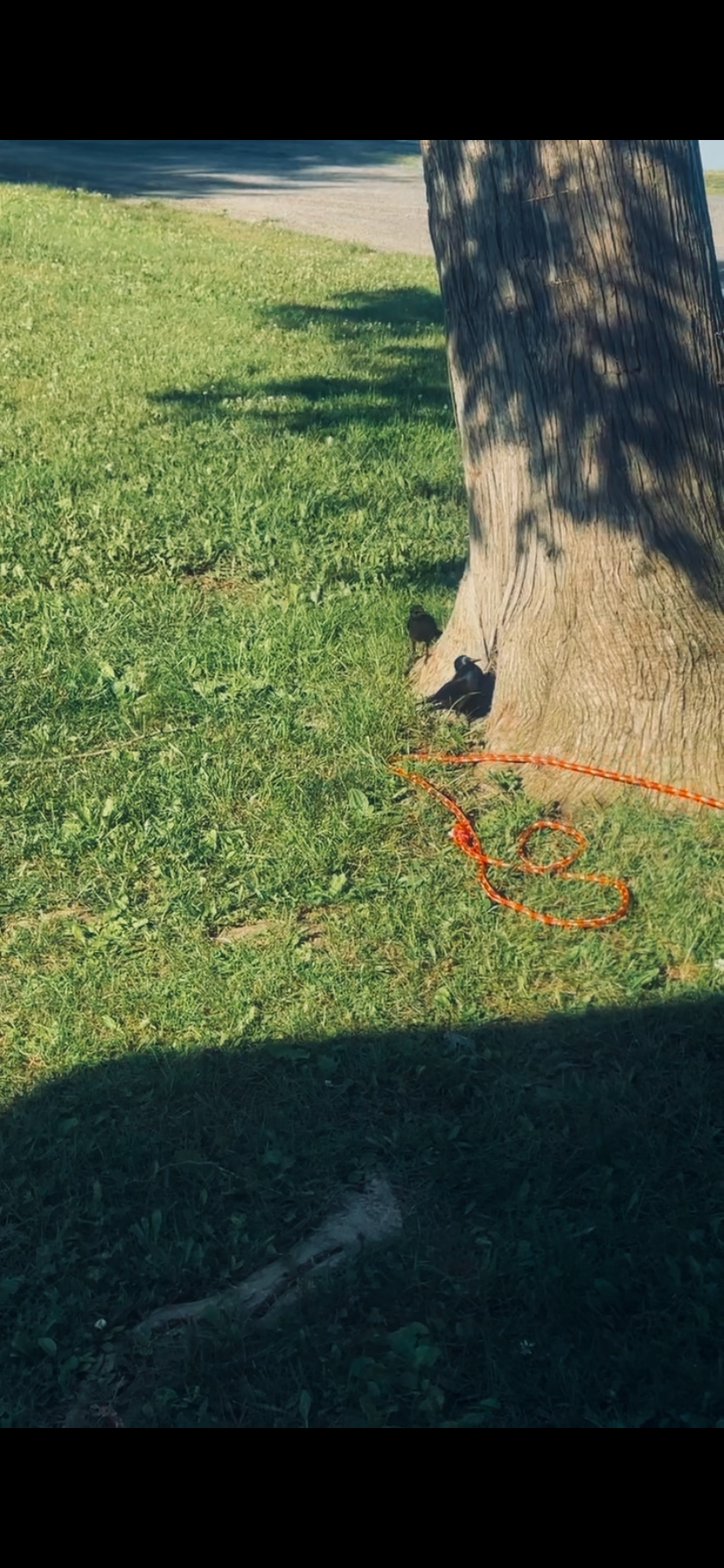
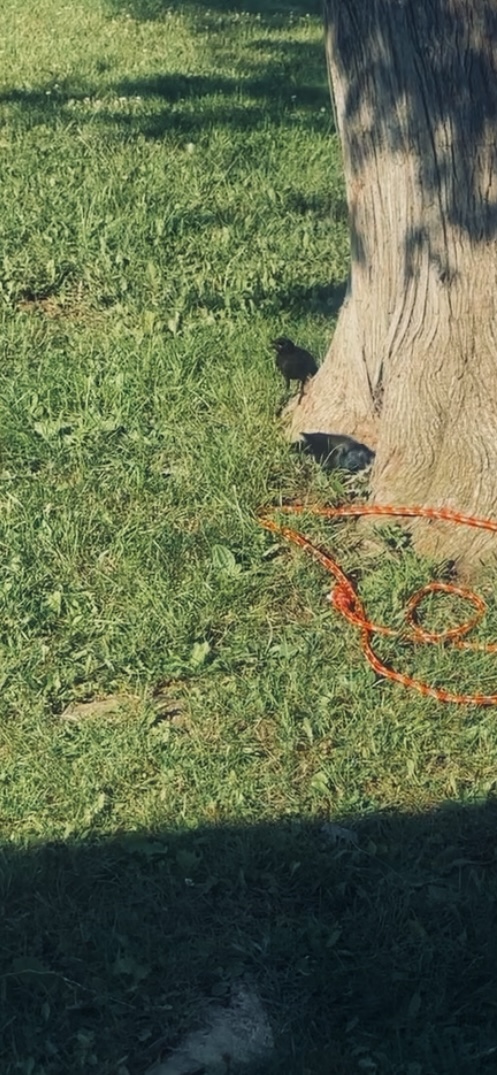
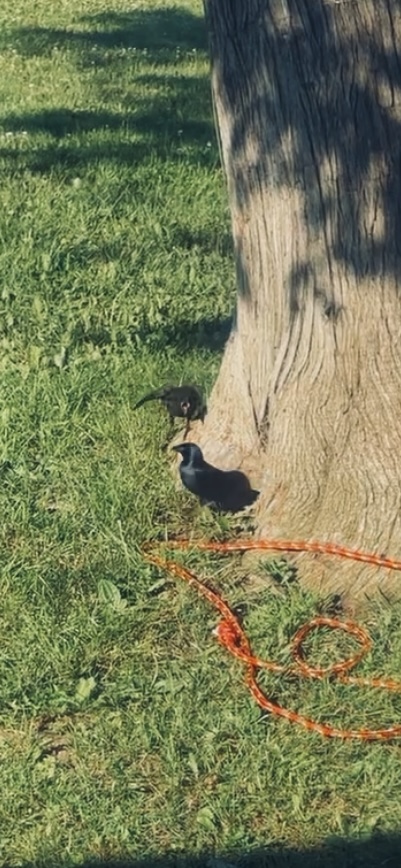
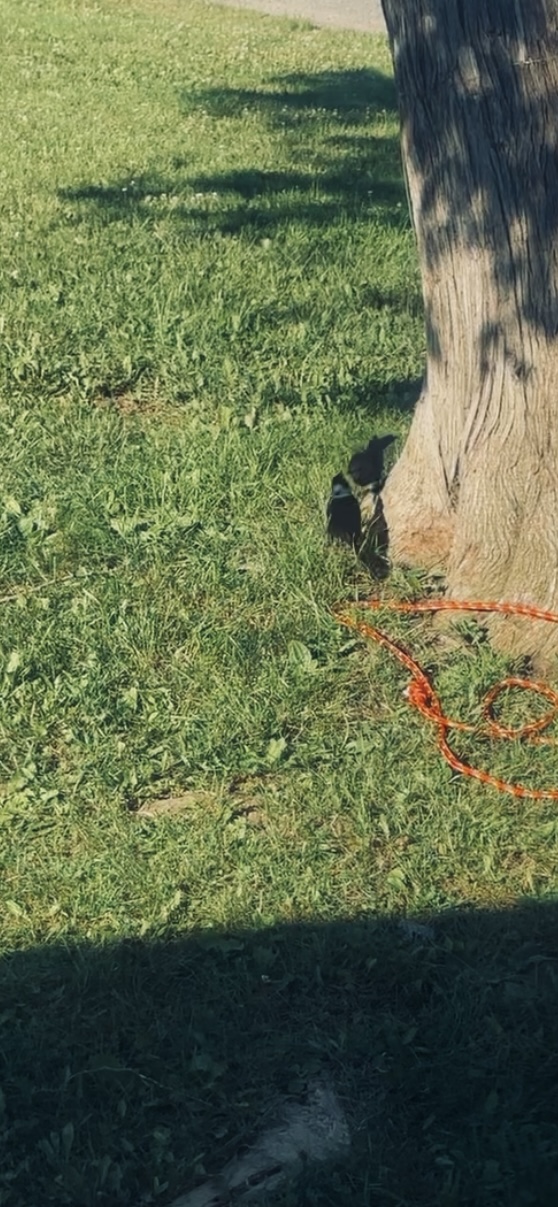
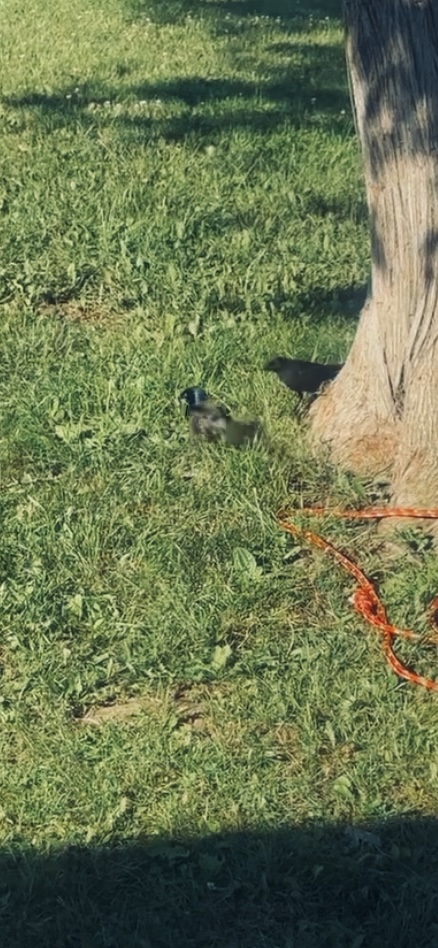
A few days ago, I had the pleasure of observing a parent grackle with their fledgling as they poked around and looked for their breakfast. In fact, the calls of the fledgling are what alerted me to the pair. Despite looking like a full-grown bird (minus the colorful markings and shine of the adult grackle), the fledgling cried just like a hatchling. It was funny to see a large bird chirping at its parent for food. By far, the most interesting part was when the parent grackle fed its baby just like they would’ve done if the two had still been in the nest.

Check out the freezeframes I was able to get from a video of that morning below! (The original video was giving me some issues, so I decided the slideshow below would work. It allowed me to emphasize the shot of the baby opening it’s mouth as well. One of the tell-tale signs that you are watching a fledgling and not an adult bird is that fledglings usually have wide mouths similar to baby birds. The image below is a nice example of this).

Almost Easter!

Here in my area, it feels like the seasons are going back and forth, trying to decide on change.

In recent weeks, I’ve been able to take advantage of the—sometimes—warmer weather and explore some new trails. I’ve been fortunate enough to stumble upon a couple trails that have raised walkways through wetland areas.

These trails are absolute gems for anyone who enjoys birdwatching. Because the elevated trails are built right through the wetland, there’s a great chance of seeing birds who otherwise may be difficult to come upon due to their desire to keep close to water.

One waterfowl I’ve seen, and very much enjoyed watching, is the hooded merganser. This species is fairly common, but still a fun sight to see when one considers it in comparison with other ducks. The hooded merganser has a bit of a poofy haircut that makes him look like he has just come out of the salon with a new hairdo. Unlike a lot of waterfowl that have sleek and smooth feathers surrounding their heads, the hooded merganser male can easily be identified from far away due to his puffy, black head and white stripe that seems to dash across his face.

As I’ve seen these creatures out and about, I have noticed that they don’t mind socializing with large groups of mallards. So next time you go on your birdwatching walk and see a group of mallards, don’t be surprised if you see a duck who looks like he’s rocking a Cruella de Vil cut. It’s probably just a hooded merganser.

Winter Travel

Happy holidays!

This happens to be one of my favorite times of the year. Between Thanksgiving and Christmas, I always find that I have so much to do! The second novel in the Birdwatching Journalist Cozy series was released in early November, and I’ve been taking a short writing break to recharge the mind.

Humans aren’t the only species that like to relax a bit around the holidays. It’s no secret that many bird species migrate during the colder months and take a break from the taxing demands of raising chicks. Some species, like the hummingbird, always come to mind when I think about the greatest migrators.

I’m familiar with seeing the birds frequently in the summers when I visit Ontario, but these little birds (who can be surprisingly aggressive if nectar is involved) zoom pretty far south during the winter. Let’s just say, cruise ships aren’t the only things stopping by the Caribbean and Mexico this time of year. I encourage you to study a migration map if you’re interested in seeing how far they travel from home.

One thing that confuses new birdwatchers in the winter is when they see a bird out in the snow. I’ve heard people ask before, “did that bird forget to migrate?” Bird migration seems to be one of the first lessons children are taught in school, how could some of these birds forget to fly south?

The answer is surprisingly simple. Birds only fly south if they have to fly south. Unlike us, who will be flocking the sandy beaches of Florida in the coming weeks for entertainment, birds fly south because they run out of food sources. Birds that rely heavily on food that prospers in warm weather would starve if they didn’t go south.

Going back to the hummingbird, one of their favorite treats is flower nectar. Flowers don’t bloom in harsh, snowy weather, so the birds move south where flowers are still in bloom. Insect hunters will also disappear. Many water birds migrate as well. While I don’t know the official reason for the departure of these webbed-footed birds, I wouldn’t be surprised if the difficulty of fishing on a frozen lake or pond is a factor.

So who does stick around in the cold? Birds that don’t need to migrate tend to feast on berries and seeds. The cardinal and blue jay always come to mind because of their bright colors. So, next time you have a snowstorm and notice a cardinal couple mingling in the snow, don’t be too surprised. They tend to stay close to home, even during the holidays.