Birding With Warm Thoughts

With the holidays upon us, for many, it is that time of year for destination travel. So even though the temperatures are dropping outside my window, and I’ve been stacking the books up, readying myself for hours of reading under cozy blankets, I’ll be focusing my thoughts on someplace warm, maybe even tropical!

A lot of birds migrate in the winter months from the United States and Canada to the Caribbean, Mexico, and Central America, but not all birds travel far. Some are year-round inhabitants to the sun kissed tropics.

One of my favorite birds who doesn’t have to concern themselves with harsh winters is the Scarlet Macaw. This beautiful bird can be found in humid rainforests. Their lifespans are long for birds, with some able to live into their 80s or older. They are incredibly loud birds, with many mistaking their aggressive calls for other, often more dangerous, animals in the rainforest. Despite their vocalizations, they greatly enjoy socializing with others and preening their partners.
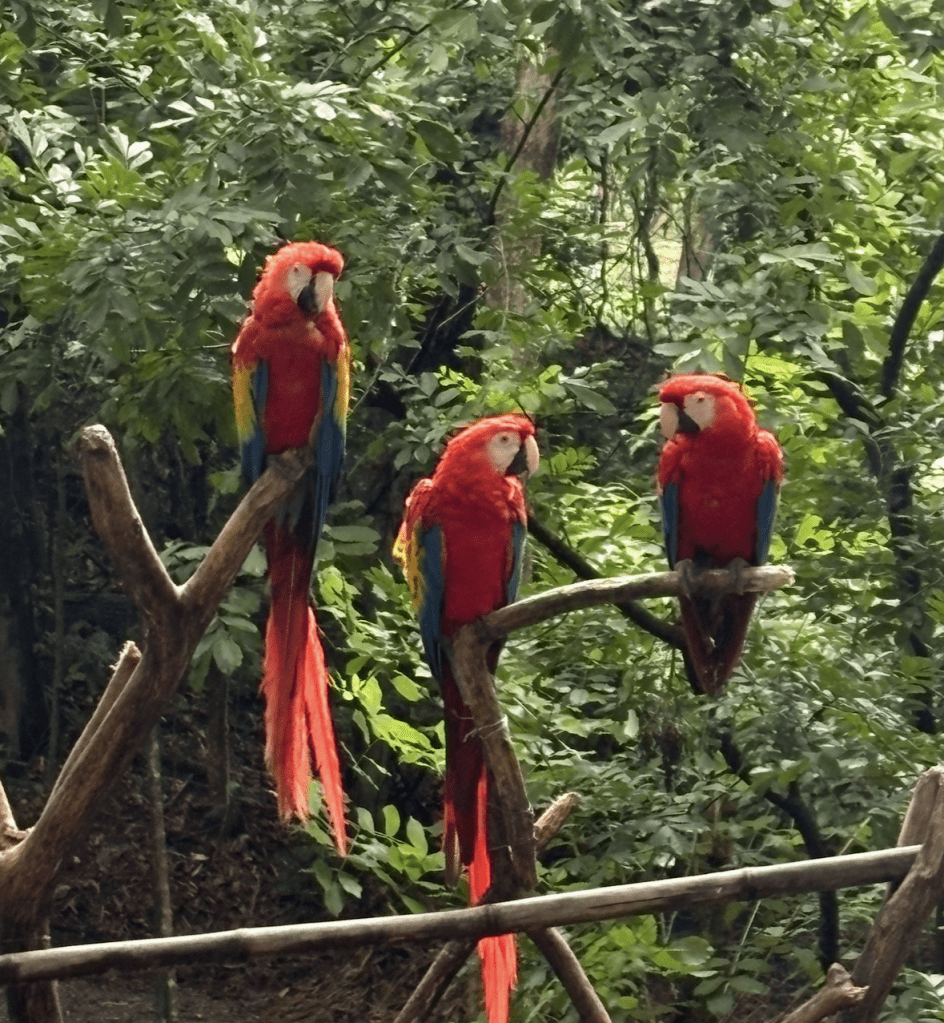
Three Scarlet Macaws at an eco-park in Honduras. These birds can freely roam the open forest.

Not all tropical birds seem as otherworldly as the Scarlet Macaw. Another bird that is easy to spot in the tropics is the great-tailed grackle. The males look similar to the common grackle seen in the United States and Canada with the exception being that the tropical counterparts are much larger. (This in itself is fascinating as animal species tend to be smaller when they live closer to the equator as opposed to away from it! Look up “Bergmann’s Rule if you would like a deep-dive.)

Male and female great-tailed grackles in Mexico.

So as the cold bears down upon many of us in the northern hemisphere, maybe the thoughts of these beautiful birds will keep you warm.

Sending you cozy thoughts. Until next time!

P.S. If you’re interested in learning more about bird migration, I recommend this interactive map from Audubon.org. The Indigo Bunting is a nice bird to start with since its winter and summer zones are easily distinguished on the map. I’m a fairly amateur birder, so I’m sure that others with more experience and knowledge will definitely enjoy the app as much as I did, if not more!

Winter Travel

Happy holidays!

This happens to be one of my favorite times of the year. Between Thanksgiving and Christmas, I always find that I have so much to do! The second novel in the Birdwatching Journalist Cozy series was released in early November, and I’ve been taking a short writing break to recharge the mind.

Humans aren’t the only species that like to relax a bit around the holidays. It’s no secret that many bird species migrate during the colder months and take a break from the taxing demands of raising chicks. Some species, like the hummingbird, always come to mind when I think about the greatest migrators.

I’m familiar with seeing the birds frequently in the summers when I visit Ontario, but these little birds (who can be surprisingly aggressive if nectar is involved) zoom pretty far south during the winter. Let’s just say, cruise ships aren’t the only things stopping by the Caribbean and Mexico this time of year. I encourage you to study a migration map if you’re interested in seeing how far they travel from home.

One thing that confuses new birdwatchers in the winter is when they see a bird out in the snow. I’ve heard people ask before, “did that bird forget to migrate?” Bird migration seems to be one of the first lessons children are taught in school, how could some of these birds forget to fly south?

The answer is surprisingly simple. Birds only fly south if they have to fly south. Unlike us, who will be flocking the sandy beaches of Florida in the coming weeks for entertainment, birds fly south because they run out of food sources. Birds that rely heavily on food that prospers in warm weather would starve if they didn’t go south.

Going back to the hummingbird, one of their favorite treats is flower nectar. Flowers don’t bloom in harsh, snowy weather, so the birds move south where flowers are still in bloom. Insect hunters will also disappear. Many water birds migrate as well. While I don’t know the official reason for the departure of these webbed-footed birds, I wouldn’t be surprised if the difficulty of fishing on a frozen lake or pond is a factor.

So who does stick around in the cold? Birds that don’t need to migrate tend to feast on berries and seeds. The cardinal and blue jay always come to mind because of their bright colors. So, next time you have a snowstorm and notice a cardinal couple mingling in the snow, don’t be too surprised. They tend to stay close to home, even during the holidays.