Almost Easter!

Here in my area, it feels like the seasons are going back and forth, trying to decide on change.

In recent weeks, I’ve been able to take advantage of the—sometimes—warmer weather and explore some new trails. I’ve been fortunate enough to stumble upon a couple trails that have raised walkways through wetland areas.

These trails are absolute gems for anyone who enjoys birdwatching. Because the elevated trails are built right through the wetland, there’s a great chance of seeing birds who otherwise may be difficult to come upon due to their desire to keep close to water.

One waterfowl I’ve seen, and very much enjoyed watching, is the hooded merganser. This species is fairly common, but still a fun sight to see when one considers it in comparison with other ducks. The hooded merganser has a bit of a poofy haircut that makes him look like he has just come out of the salon with a new hairdo. Unlike a lot of waterfowl that have sleek and smooth feathers surrounding their heads, the hooded merganser male can easily be identified from far away due to his puffy, black head and white stripe that seems to dash across his face.

As I’ve seen these creatures out and about, I have noticed that they don’t mind socializing with large groups of mallards. So next time you go on your birdwatching walk and see a group of mallards, don’t be surprised if you see a duck who looks like he’s rocking a Cruella de Vil cut. It’s probably just a hooded merganser.
Winter Travel

Happy holidays!

This happens to be one of my favorite times of the year. Between Thanksgiving and Christmas, I always find that I have so much to do! The second novel in the Birdwatching Journalist Cozy series was released in early November, and I’ve been taking a short writing break to recharge the mind.

Humans aren’t the only species that like to relax a bit around the holidays. It’s no secret that many bird species migrate during the colder months and take a break from the taxing demands of raising chicks. Some species, like the hummingbird, always come to mind when I think about the greatest migrators.

I’m familiar with seeing the birds frequently in the summers when I visit Ontario, but these little birds (who can be surprisingly aggressive if nectar is involved) zoom pretty far south during the winter. Let’s just say, cruise ships aren’t the only things stopping by the Caribbean and Mexico this time of year. I encourage you to study a migration map if you’re interested in seeing how far they travel from home.

One thing that confuses new birdwatchers in the winter is when they see a bird out in the snow. I’ve heard people ask before, “did that bird forget to migrate?” Bird migration seems to be one of the first lessons children are taught in school, how could some of these birds forget to fly south?

The answer is surprisingly simple. Birds only fly south if they have to fly south. Unlike us, who will be flocking the sandy beaches of Florida in the coming weeks for entertainment, birds fly south because they run out of food sources. Birds that rely heavily on food that prospers in warm weather would starve if they didn’t go south.

Going back to the hummingbird, one of their favorite treats is flower nectar. Flowers don’t bloom in harsh, snowy weather, so the birds move south where flowers are still in bloom. Insect hunters will also disappear. Many water birds migrate as well. While I don’t know the official reason for the departure of these webbed-footed birds, I wouldn’t be surprised if the difficulty of fishing on a frozen lake or pond is a factor.

So who does stick around in the cold? Birds that don’t need to migrate tend to feast on berries and seeds. The cardinal and blue jay always come to mind because of their bright colors. So, next time you have a snowstorm and notice a cardinal couple mingling in the snow, don’t be too surprised. They tend to stay close to home, even during the holidays.

Famous Feathers

I can’t believe it’s almost autumn and time for the leaves to fall. I’ve spent most of the summer working on the second book in the Emma Finch Bird Watching series (due to be released sometime soon), so time has flown by extra fast!

While I do love to write in the summer, there are some other activities I love to partake in. One in particular is travel. On a recent trip to Milwaukee, I was fortunate enough to learn about a very special bird called Gertie the Duck.

According to the legend, Gertie laid several eggs near one of Milwaukee’s frequently traveled bridges. Once the ducklings broke through their shells, she and her surviving brood were relocated to a popular department store’s window for onlookers to observe. Eventually, an effort was organized to relocate Gertie and her chicks to a more duck-appropriate location. To this day, Gertie’s statue still overlooks the Wisconsin Avenue Bridge.

As someone who enjoys birdwatching, it was exciting to learn about a famous bird. I have no doubt that there are more stories like this one in the world, and I hope I get to discover them in my future travels.

End Note: There is lots of other research available about Gertie and her ducklings. If you’re interested, I encourage you to seek out some of the more detailed stories available online.

Summer Showers

I hope everyone is having a wonderful summer! I took a short break from updating the blog this spring, but I’m happy to say that I’m back. I had a few different ideas as to what I could write about for my first summer posting, but I’ve decided to settle on the bird bath.

Summertime is hot, so it’s a great time to observe birds frolicking in the water after a sun shower—or even a storm. Certain songbirds love bathing and getting their feathers a little wet. Specifically, the robin comes to mind when I think about birds who will be attracted by a small bird bath in the yard.

One bird I recently observed bathing this summer was the chipping sparrow. I watched the little red capped fellow and a mate splash around in a shallow puddle after a recent thunderstorm. I enjoyed watching them play, especially because I didn’t know this type of bird enjoyed a quick dip. Their counterparts, the house sparrow, are usually found dust bathing to help with their somewhat oily feathers. It made me wonder, do house sparrows enjoy the water too? I’ll be paying extra special attention to the puddles this summer to find out!

Spring is for Beginnings

Welcome to my second springtime post!

I’m a bit lost as to what to write about in terms of topics, but spring is the time of new beginnings, so I think I’ll start there!

As a writer, sometimes I find myself in muddy ruts filled with negative thoughts. Everything from concern over an overly simplistic plot to boring side stories paralyze my writing progress. How can I find the new beginning I need, that mysterious push to write, when I’m just not feeling myself? During times like these, I realize the importance of searching for motivation (it’s a weird thought to think we need to motivate ourselves to get motivated–but we do!).

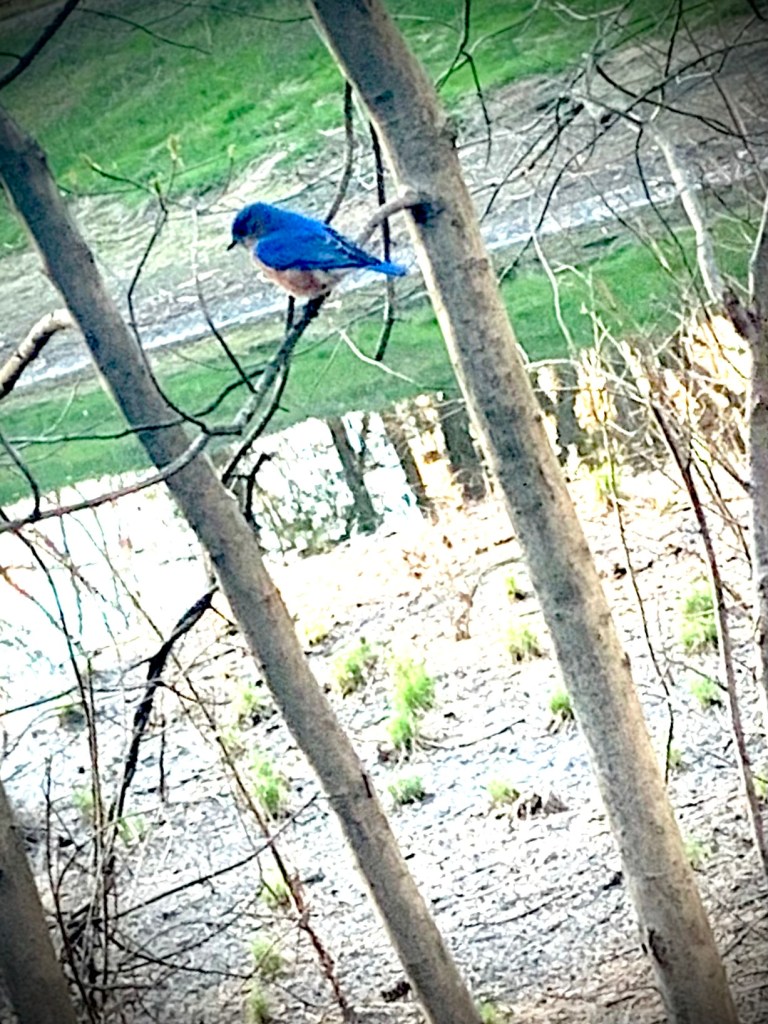
One thing that always inspires me is nature. A long walk in the park is definitely something that rejuvenates my mind, or even a nice day watching the trees outside my window can help my mind get back into the flow of things. Recently, on one of my walks, I had the chance to spot an Eastern Bluebird and get a great photo of it.

I’m fortunate enough to be in an area where these gorgeous birds like to be year-round. It doesn’t matter how many times I spot one of these colorful birds, I’m always amazed at how bright and cheery the natural world can be if we look for it. I found this bird resting on a branch in a wooded area nearby an open field. I’m no bluebird expert, but based on observation alone, I know these East Coast dwellers love wide-open spaces. While I’ve only spotted them in the woods a few times, I’m never surprised when I see them flitting from post to post in the grassy park.

Considering the bright colors and size of the bluebird, it must take a lot of confidence and bravery for the tiny creatures to make homes in such unprotected areas. In that sense, I think writers and, really, any sort of artist, can take inspiration from the birds. We too should boldly move forward with our art. We too can be the bluebirds spreading our wings across the fields.

An Eastern Bluebird on a tree limb nearby a patch of large water–most likely a stormwater pond. The photo was edited to enhance the bird’s color.

Spring is Here?

Welcome back to my blog. I didn’t know March could be such a windy month, but it sure has been so far!

One thing I like about March is that the birds are returning after spending the winter huddled away. The bird that always seems to make the first dramatic appearance of the season is the robin. Who could miss these birds with their bright red, puffy chests as they poke around the ground? Personally, I’ve always enjoyed watching them run across pavement. They look similar to cartoon detectives tailing a suspect with their sudden stops and bursts.

I’ve always been curious about why robins appear in such big groups in the early spring. I rarely just see one robin hopping about. Usually, the lawns and parks seem to be covered in them when spring is in the air. After pondering my question a bit, I decided to do some research, and I wasn’t disappointed by what I found out. The reasons robins appear in large groups on grassy spaces in the early spring is that they enjoy worms and other ground dwelling grubs. Because the ground begins to thaw in spring, March usually presents itself as one of the best times for the birds to gather up and go grub hunting! I guess the old saying is true, “the early bird does get the worm.”

Happy February!

Happy February! I cannot believe that the first month of the new year is already gone. Murder at Nuthatch Nest was launched on amazon at the end of January, and it is now available in both print and ebook through amazon! More information can be found on the “books” page of the website. If you have read the book and enjoyed it, I would love to hear from you, so feel free to leave an amazon review!

In terms of birdwatching, February can be a great birdwatching month. It can give watchers the opportunity to see migratory birds that they normally would not see, or catch birds that are harder to catch in the summer when the trees have a lot of foliage.

One bird I see frequently in the winter is the Canadian Goose. They love to spend time in grassy areas nearby water. Recently, my area has had a lot of winter rain (I wish it were snow!), and it’s been pretty cool to see how the geese react to this type of rain. One thing I’ve noticed is that if they’re not gulping up the water, then they’re standing on one leg with the other tucked near their bodies. I recently learned that this behavior is to help keep them warm when they’re cold. It makes me wonder though: are birds right footed and left footed like humans are right handed or left handed? I suppose that’ll be the next thing I research!

First Post–The Egg

Welcome to my website and birdwatching blog! This first post is more of an introduction than a post about my birding adventures. I’m currently in the process of building the website as I write this post, so I thank you for putting up with all of the extra construction.

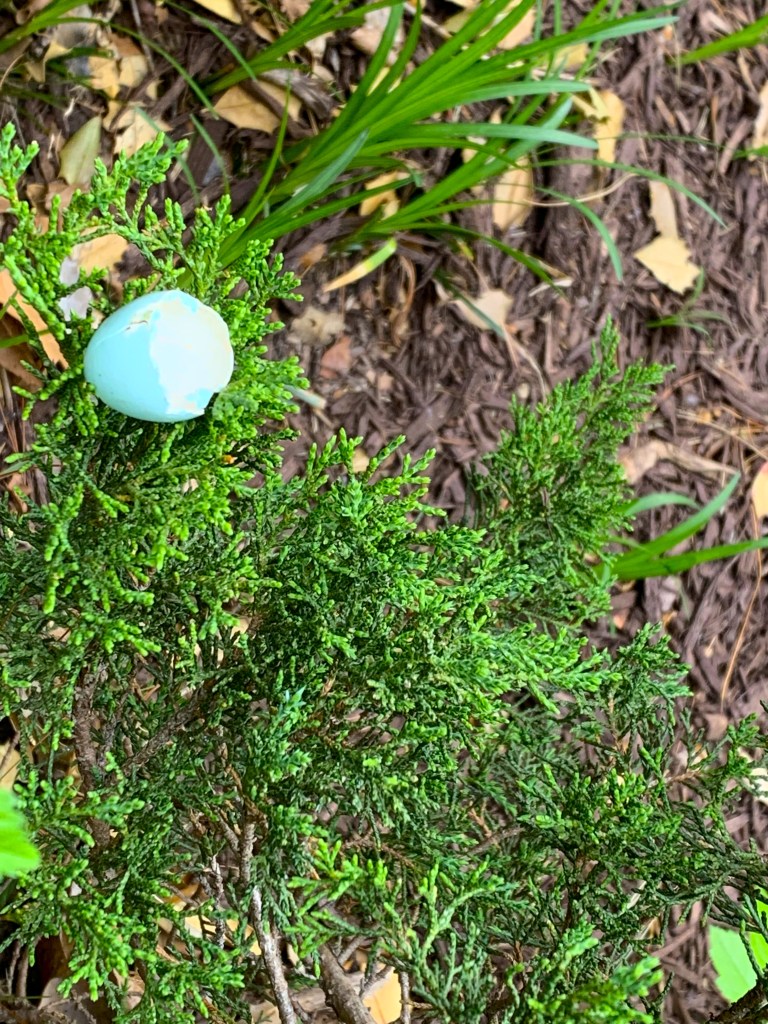
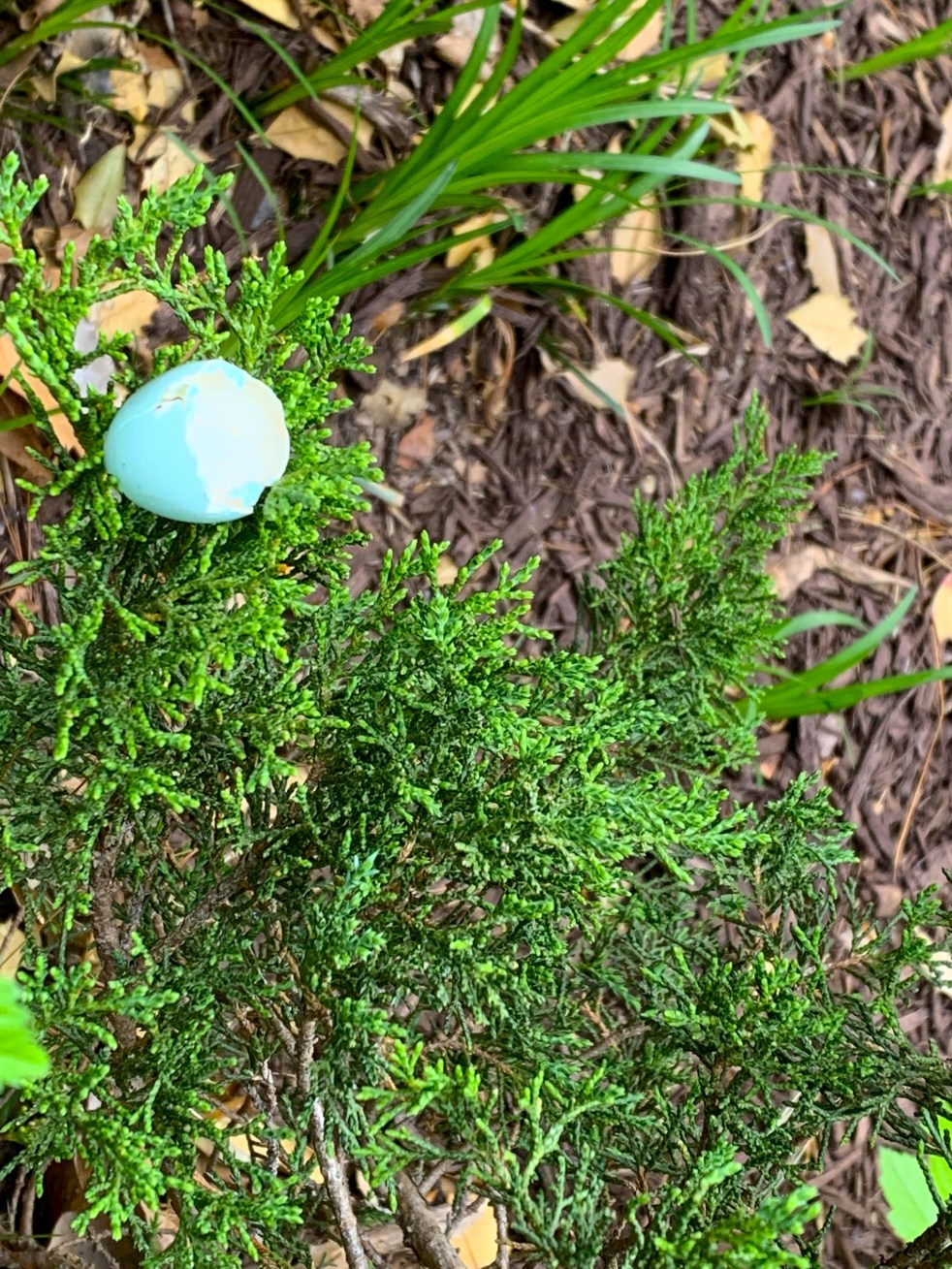
The photograph used on my pages (including the introduction to the blog page) was taken last spring (May 2022). I found the egg in a bush nearby a dust bathing spot popular with a quarrel of sparrows. Until last spring, I had no idea that sparrows enjoyed dust bathing so much. In fact, little divots were located all around the bush!

One interesting fact about light blue eggs like this is that people tend to assume right away that they are robin eggs. In fact, many different bird species lay colorful eggs like this one. While I’m not completely sure what type of bird this shell belonged to, I do have my suspicions that it might have belonged to a starling. European starlings, an invasive bird in the United States, happen to be rather aggressive when it comes to nesting, and last spring, the sparrows had been in constant competition with a group of starlings. I wouldn’t be surprised to learn that one of the many starlings had decided to make a sparrow nest their own before laying this colorful egg!